



The Dow Jones Index remained in a tight range near its all-time high of $49,705 as traders waited for the first Federal Reserve interest rate decision of the year and the Magnificent 7 earnings.
Summary
- The Dow Jones Index has formed a rising wedge pattern on the daily chart
- The Federal Reserve will deliver its first interest rate decision of the year on Wednesday.
- Many companies, including those in the Magnificent 7, will publish their numbers.
The Dow Jones, which tracks 30 top blue-chip companies, was trading at $49,160, up by 35% from its lowest level in 2025, but down 0.6% for the week.
The index will likely experience high volatility next week as the Federal Reserve delivers its first interest rate decision of the year. Economists polled by Reuters expect the bank to leave interest rates unchanged between 3.5% and 3.75%.
This interest rate decision will provide more information about what to expect in the next meetings since officials have received more data after the last meeting in December. A report released this week showed that the US GDP expanded by 4.4% in the third quarter, higher than the previous estimate of 4.3%.
More data released this month showed that the headline Consumer Price Index rose to 2.6% in December, while core CPI was at 2.7%. Another report showed that the unemployment rate improved to 4.4% in December.
The Dow Jones Index will also react to key corporate earnings from the so-called Magnificent 7: Apple, Amazon, Alphabet, Meta, Microsoft, Nvidia and Tesla.
All these companies, valued at over $16 trillion, will be watched closely. After all, they are the biggest spenders in the artificial intelligence industry, which has helped to push the stock market to a record high. Strong financial results will likely push the index higher.
The other top Dow Jones constituents that will report earnings are Caterpillar, Boeing, UnitedHealth, Chevron, and IBM.
Dow Jones Index technical analysis
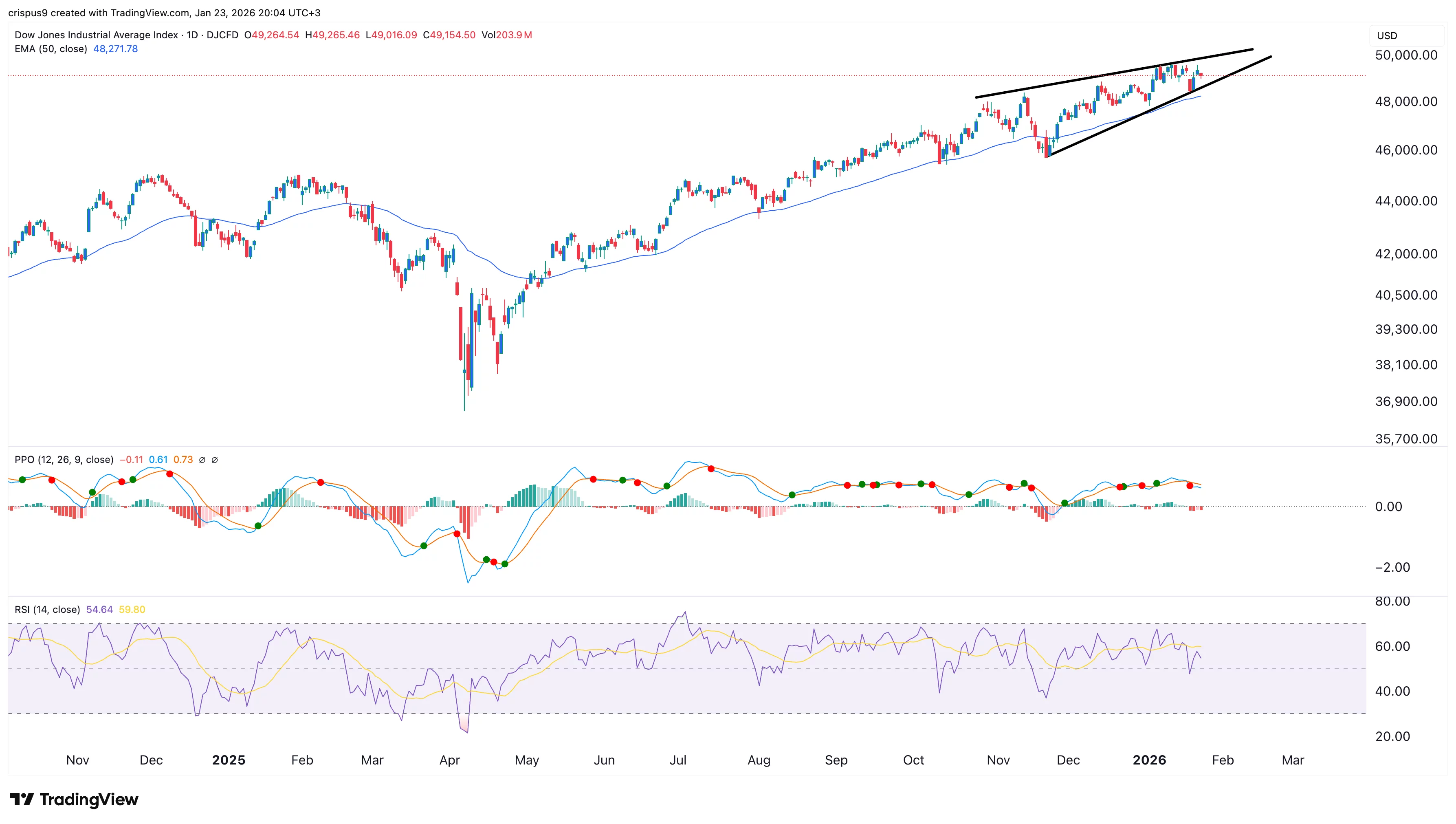
The daily timeframe chart shows that the Dow Jones Index has remained in a tight range in the past few weeks. A closer look shows that the index has formed a rising wedge pattern, with the two lines nearing their confluence.
The index has also formed a bearish divergence pattern, as the Relative Strength Index and the MACD have continued to fall over the past few months.
Therefore, the index will likely retreat, potentially to the psychological level at $48,000 and then rebound. This aligns with Tom Lee’s recent prediction. The Bitmine chair expects the stock market to drop by between 10% and 20% before rebounding.
Broader look
U.S. stocks were mixed Friday as the Nasdaq rose 0.3%, extending gains on easing geopolitical fears, while the S&P 500 slipped 0.1% and the Dow fell 0.8%, dragged down by a 3% drop in Goldman Sachs.
Markets rebounded earlier in the week after President Trump walked back threatened tariffs on eight European nations and signaled progress toward a framework deal involving Greenland, fueling what investors dubbed the “TACO” trade — a belief that aggressive rhetoric may give way to negotiation.
The S&P 500 and Nasdaq are on track for a second straight weekly decline.