
Disclosure: This article does not represent investment advice. The content and materials featured on this page are for educational purposes only.
In a consolidating Bitcoin market and evolving U.S. crypto policy, SolStaking offers institutions structured, asset-backed contracts that prioritize predictable settlement over speculation.
Summary
- Bitcoin trading around $90K–$92K and regulatory clarity from the GENIUS and CLARITY Acts are shifting institutional focus toward execution and rules-based participation.
- Fixed-term, USD-denominated contracts settle in major digital assets and are designed for predictability, not price speculation.
- Contracts are linked to real-world cash flows, including bonds, commodities, and infrastructure, and supported by institutional-grade security, audits, and insurance.
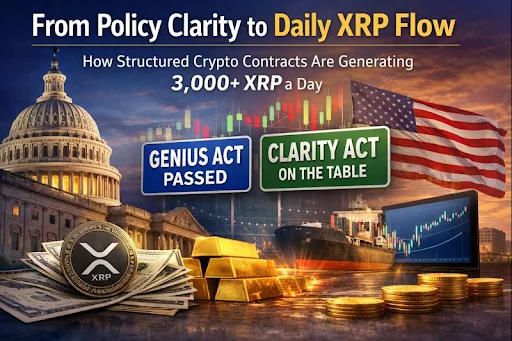
Bitcoin has been consolidating around the $90,000–$92,000 range, reinforcing a market environment where price direction is less predictable, and institutions are prioritizing execution over timing.
In Washington, the policy backdrop is moving from ambiguity to implementation: the GENIUS Act has already been signed into law, while the Digital Asset Market Clarity Act of 2025 (CLARITY Act) continues to advance through the legislative process.
Meanwhile, the XRP Ledger continues shipping infrastructure upgrades (including recent rippled releases that add new capabilities and stability fixes), reinforcing its positioning as settlement-grade rails rather than a purely speculative network.
Against that backdrop, institutional interest is increasingly shifting toward rule-based, time-bound participation models, and that is where SolStaking fits.
SolStaking’s core advantage: Structure, not speculation
SolStaking does not offer trading or traditional staking. Instead, it provides predefined, fixed-term contracts designed around clarity and execution discipline:
- Terms and durations disclosed upfront
- Automated execution through maturity
- No open-ended lock-ups
- USD-denominated contract values
- Settlement in major digital assets, including XRP, SOL, BTC, ETH, and USDT
The objective is predictable settlement, not price speculation.
Asset-backed and insulated from market volatility
SolStaking’s contracts are linked to real-world asset (RWA) cash flows rather than token price appreciation.
Underlying exposure includes investment-grade bonds, physical gold, industrial metals, logistics infrastructure, agriculture, marine industries, and clean energy projects, assets designed to generate revenue through established economic activity.
Operationally:
- Cash flows are generated off-chain
- Performance is accounted for outside the blockchain
- Settlement data is reflected on-chain
- Smart contracts distribute proceeds according to predefined rules
Blockchain serves primarily as a settlement and transparency layer, while cash-flow generation remains off-chain and insulated from on-chain volatility.
Illustrative Contract Structures
The examples below illustrate structure only and do not represent performance guarantees:
| Contract Type | Starting Amount | Term | Estimated Settlement |
| Trial Plan | $100 | 2 days | ~$108 |
| XRP Flagship Plan | $30,000 | 30 days | ~$44,400 |
| SOL Income Plan | $100,000 | 40 days | ~$174,000 |
| BTC Flagship Plan | $300,000 | 50 days | ~$630,000 |
Figures are illustrative. Actual terms are governed by published agreements.
Across active contracts, aggregate settlement activity can reach 3,000+ XRP per day, reflecting platform scale rather than guaranteed outcomes.
Security as a baseline
SolStaking operates through a U.S.-registered entity, with client assets segregated from operating funds. Core controls include:
- Annual audits by PwC
- Custody insurance arranged through Lloyd’s of London
- Enterprise-grade protection via Cloudflare and McAfee
- Multi-layer encryption with continuous monitoring
These measures are designed to align with institutional expectations for custody, auditability, and operational transparency.
Getting started in three steps
Step 1: Register
Create an account and complete identity verification.
Step 2: Select a contract
Choose a fixed-term contract based on capital allocation and duration.
Step 3: Activate
Once activated, execution and settlement proceed automatically until maturity.
Bottom line
In a market defined by range-bound price action and tighter risk controls, institutions are increasingly prioritizing structure: defined rules, fixed timelines, and predictable settlement.
With U.S. policy moving toward clearer frameworks and settlement infrastructure continuing to mature, asset-backed contract models like SolStaking present a structured alternative focused on execution discipline, not speculation.
To learn more about SolStaking, visit the official website. Business inquiries: [email protected]
Disclosure: This content is provided by a third party. Neither crypto.news nor the author of this article endorses any product mentioned on this page. Users should conduct their own research before taking any action related to the company.