


Robinhood stock recovered more than 2% on Thursday after Bernstein maintained its $160 target, betting that tokenization and prediction markets can offset weaker crypto trading.
Summary
- Bernstein maintained an Outperform rating and $160 target, implying roughly 81% upside from Thursday’s close.
- Robinhood’s second-quarter net revenue rose 32% year over year to $1.31 billion.
- Event contracts generated $156 million, surpassing the company’s $100 million in crypto trading revenue.
- HOOD traded at $88.55, but remained below its 20-, 50- and 100-day moving averages.
Robinhood stock rebounds from $83.68
Robinhood Markets shares traded at $88.55 on Friday, up approximately 2.25% after moving between $83.68 and $89.48 during the session. Despite the rebound, HOOD remained about 26% below its July high near $120.
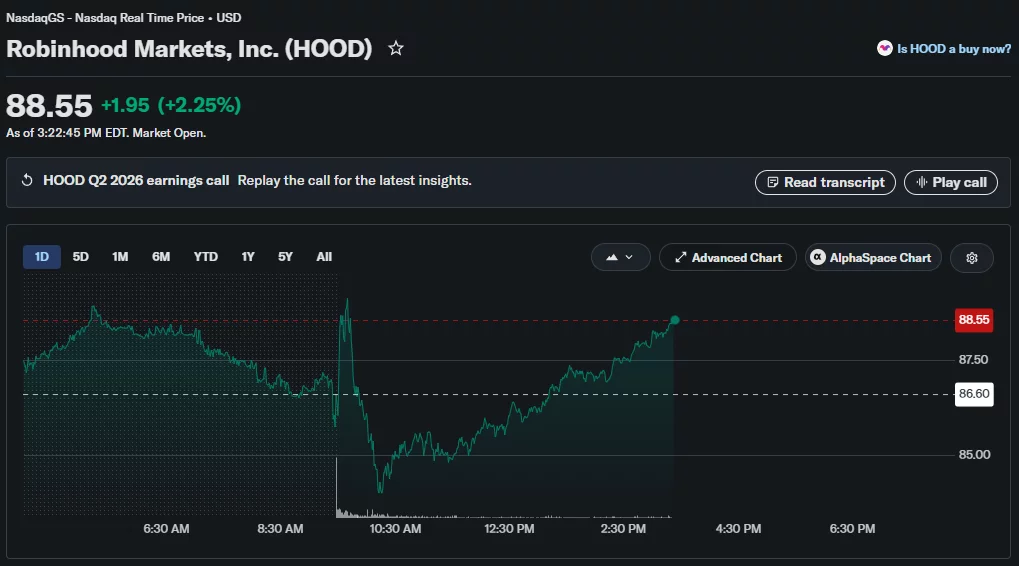
HOOD had closed Wednesday at $89.84 before coming under renewed selling pressure. Thursday’s recovery kept the stock above its 200-day simple moving average at approximately $86.52, a level that could determine whether the recent decline develops into a deeper correction.
Bernstein maintained its Outperform rating and $160 price target following Robinhood’s second-quarter results. From Thursday’s closing price, the target represents potential upside of about 81%.
Goldman Sachs also retained a Buy rating but reduced its 12-month target from $137 to $118. The revised target still implies more than 33% upside, though it reflects a more cautious outlook for near-term growth.
Robinhood reported second-quarter net revenue of $1.31 billion, up 32% from $989 million a year earlier. The result exceeded analysts’ consensus estimate of approximately $1.26 billion.
Prediction markets overtake crypto revenue
Bernstein’s bullish case rests partly on Robinhood’s expansion beyond conventional stock and cryptocurrency trading. The brokerage identified prediction markets, tokenized stocks and blockchain infrastructure as longer-term revenue drivers.
Robinhood’s Rothera exchange went live in June and has processed more than 3.5 billion contracts. Around 2.1 billion contracts changed hands during the second quarter, generating $17 million in revenue.
Total event-contract revenue reached $156 million during the quarter, exceeding the $100 million generated by crypto trading. Bernstein described Rothera as the third-largest U.S. exchange in its category.
The figures show that prediction markets are becoming a larger part of Robinhood’s business as weaker digital-asset activity weighs on transaction revenue. Bernstein cut its estimate for Robinhood’s 2026 crypto trading revenue by 49% to reflect lower market volumes.
Commenting on how Rothera could develop, Bernstein analysts said:
“Management expects a greater share of prediction market flow to migrate to Rothera over time, while continuing to distribute event contracts from third-party exchanges and retaining the longer-term optionality to offer Rothera as a B2B platform for other FCMs.”
That strategy would allow Robinhood to earn revenue from its own exchange while continuing to distribute contracts supplied by outside venues. A future business-to-business offering could also provide access to other futures commission merchants, though that remains a longer-term option rather than a confirmed source of revenue.
Tokenization becomes a second growth pillar
Bernstein also pointed to Robinhood Chain, Bitstamp, Robinhood Earn and tokenized stocks as evidence that the company is developing infrastructure beyond its retail brokerage.
Robinhood Chain has recorded more than $12 billion in decentralized exchange volume and processed over 150 million transactions since its launch. Robinhood Earn has attracted more than $200 million in deposits.
Stock Tokens are available through Robinhood Wallet in more than 120 countries, extending the company’s tokenization business outside the United States. The service gives eligible international users blockchain-based exposure to listed securities, while U.S. investors continue to access conventional shares through Robinhood’s regulated brokerage platform.
Robinhood has also opened its Agentic Trading platform to its full customer base. The system lets customers connect artificial intelligence agents through Robinhood’s Model Context Protocol server and assign specific investing tasks.
These products widen Robinhood’s addressable market, but they also introduce execution and regulatory risks. Tokenized securities can face different ownership, disclosure, and investor-protection rules across jurisdictions, while prediction markets remain under scrutiny from U.S. federal and state authorities.
HOOD must reclaim $96 to strengthen recovery
Robinhood’s daily chart remains technically weak despite Thursday’s rebound. HOOD is trading below its 20-day moving average at $103.79, its 50-day average at $96.67, and its 100-day average at $99.30.
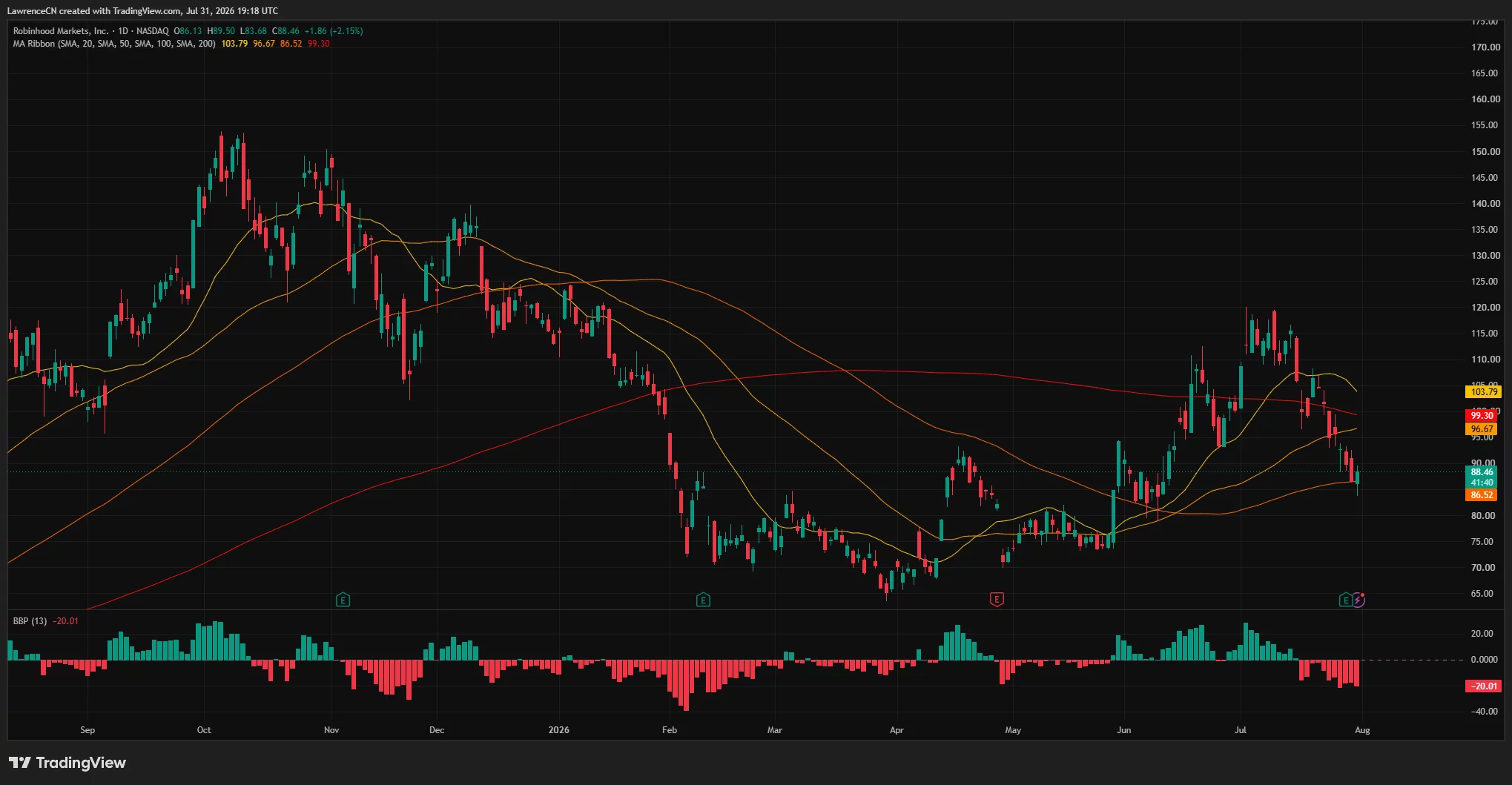
The cluster between $96.67 and $103.79 creates a broad resistance area. A close above the 50-day average would be the first sign that buyers are regaining control, while a move above $103.79 could reopen a path toward the July range between $110 and $120.
Bear-bull power stood at minus 20.01, showing that sellers still hold the near-term advantage. Negative bars have also expanded during the latest retreat, suggesting that Thursday’s bounce has not yet reversed the broader loss of momentum.
On the downside, the 200-day moving average near $86.52 provides immediate support. HOOD briefly traded below that level before recovering, making the $83.68 intraday low the next level to watch if selling resumes.
A sustained break below $83.68 could expose the June consolidation area around $75 to $80. Conversely, holding above the 200-day average and reclaiming $96.67 would improve the technical outlook.
Bernstein’s $160 target depends on Robinhood converting newer products into durable revenue as crypto trading slows. For U.S. investors, the next test will be whether prediction markets and tokenization can continue expanding without tighter regulation limiting their contribution.
Disclosure: This article does not represent investment advice. The content and materials featured on this page are for educational purposes only.