


In crypto, a roadmap can describe what a project wants to build. Public code shows what developers have started to build already. That distinction is especially important for a memecoin launchpad, where users need to know how funding, token supply, refunds, and liquidity are meant to work.
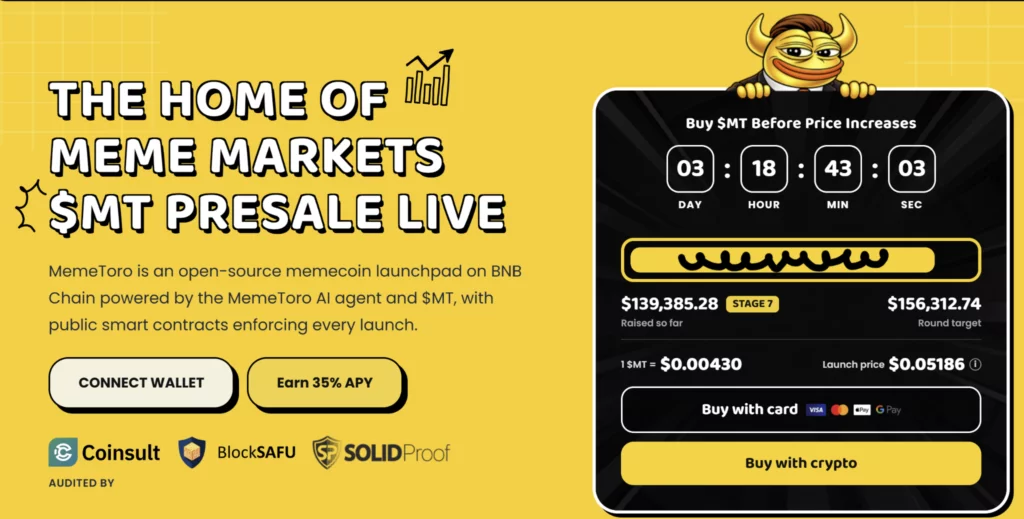
MemeToro has released 1,373 lines of Solidity code across 17 files in its latest update. The project is building an AI-led fair-launch platform on BNB Chain and has raised more than $139,000 in its $0.00430 Stage 7 presale.
The open-source update gives buyers and developers a clearer view of the proposed system, including its smart-contract rules and the work still required before mainnet deployment.
About MemeToro and its new AI agent on BNB chain
MemeToro is a planned BNB Chain ecosystem for discovering, funding, and trading memecoins. Its main goal is to use an AI agent to research trends and propose launches with documented reasons instead of relying on unverified hype.
The agent is designed to collect social, market, and news evidence. It then prepares a launch manifest that users can read before deciding whether to support a round.
The launch manifest is meant to show the proposed token structure, price, funding cap, and data sources. It gives buyers more information than a standard token announcement.
MemeToro’s validators are designed to reject proposals that fail basic rules. They can reject unsupported URLs, allocation totals that do not equal 100%, insider allocation above zero, and funding terms that conflict with the proposal.
$MT is the planned ecosystem token. It is intended to support access, funding, staking, rewards, memecoin trading, prediction markets, and a news portal.
The project is therefore building both an AI proposal layer and a contract layer. The agent suggests a launch, while smart contracts are meant to enforce the accepted rules.
What a $500 $MT position could look like
At the current $0.00430 Stage 7 rate, $500 would provide about 116,279 $MT before fees. MemeToro’s displayed launch target is $0.05186.
If $MT traded at that level, the allocation would have a theoretical paper value near $6,028, or about 12.06 times the original amount.
At a $1 billion fully diluted valuation, each $MT would be worth about $0.8333 based on the stated 1.2 billion supply. The same $500 allocation could then be worth around $96,899.
These figures are illustrative. They do not account for liquidity limits, slippage, transaction fees, taxes, supply changes, or the risk that $MT trades below the purchase price.
The real opportunity depends on whether MemeToro finishes the product and attracts enough users to make its AI-led fair-launch model valuable after the presale.
The 1,373-line release builds the first contract layer
The latest update includes 17 files and 1,373 new lines of Solidity code. The main addition is FairLaunchEscrow.sol, a contract designed to hold contributor funds for one memecoin launch round.
The update also introduces ILaunchExecutor.sol. This is the planned plug-in point where future token deployment and liquidity work will connect to the escrow.
A third component, IERC20Minimal.sol, provides the basic token functions needed to support future claim payments. The release also adds documentation, architecture notes, contributor rules, and a full test suite.
The code is built with Foundry, a common Solidity toolkit used for contract development and testing. This allows outside developers to inspect the design and review how the functions are meant to work.
Open-source code does not eliminate risk. It does provide a public trail of development that buyers can compare with the project’s public claims.
The contract design focuses on what cannot happen
MemeToro’s fair-launch draft is designed without an owner, admin role, or upgrade path. This is meant to prevent a team from adding new privileges after a round goes live.
The contract locks round settings at creation. It also stores a fingerprint of the public launch manifest, so users can compare the on-chain terms with the plan they saw before contributing.
The design limits contributor funds to two outcomes: refunds or the planned liquidity process. It does not include a stated route for developer or treasury withdrawals.
The allocation logic is designed to prohibit insider supply. Contributors and liquidity must account for the total supply, while any rounding remainder goes to liquidity.
This is a major part of MemeToro’s bullish case. Instead of saying “trust us, there are no insiders,” the project is publishing code intended to make an insider allocation incompatible with the launch math.
The final system still needs independent review and real-world testing. But the initial contract structure gives the community something concrete to examine.
Tests and remaining milestones show a serious development path
MemeToro’s test suite checks the important launch states: funding caps, deadlines, thresholds, refunds, claims, and unexpected behavior from connected contracts.
Random-sequence testing is also included. This checks that the contract’s accounting remains balanced across many possible transaction orders and that users cannot claim more than they are owed.
The team added two extra tests to ensure the code reaches funded, launched, claimed, and refunded states. That is a useful detail because a passing test is not enough if it never enters the situation it is meant to verify.
The project still needs to complete the real token executor, manifest-to-contract integration, deployment scripts, factory, BNB Chain testnet launch, ERC-8004 agent identity, and independent security review.
MemeToro lists Coinsult, BlockSAFU, and SOLIDProof as audit or review providers. These give buyers three named firms to check alongside the public code and official project updates.
More Information on MemeToro ($MT) Presale Here:
Website: https://memetoro.com/
Telegram: https://t.me/memetoro_mt
YouTube: https://www.youtube.com/watch?v=gY0jgWy_DtA