



Cardano price remained under pressure near $0.16 on June 10, even as on-chain data showed that long-dormant ADA had started moving again.
Summary
- Dormant ADA movement and falling invested age suggest long-term holders are becoming active after selloff.
- Cardano price remains bearish near $0.16, while deeply oversold RSI leaves room for relief bounce.
- Futures activity stays elevated, but exchange outflows alone have not reversed ADA’s wider downtrend yet.
According to crypto.news data, the token fell 4.95% over 24 hours, 25.92% over seven days and 42.69% during the past month.
ADA traded between $0.1589 and $0.1693, with daily volume near $436 million. The sharp decline pushed the token close to its lower Bollinger Band and left momentum deeply oversold, creating conditions for a relief bounce without confirming a durable reversal.
Dormant ADA movement points to changing holder behavior
Santiment reported that Cardano’s Mean Dollar Invested Age had climbed steadily before flattening and turning lower. The indicator tracks the average age of capital invested in ADA, so a decline means older coins have started moving after long periods of inactivity.
Age Consumed also recorded several spikes over the past four to five days, including its largest reading since April. The metric multiplies the number of tokens moved by the time they remained dormant, making large spikes a sign that older holdings have returned to circulation.
“This suggests that this recent flush has motivated some long-term holders to become active again,” Santiment said.
The movement can reflect several forms of activity, including selling, wallet reshuffling or accumulation by new buyers. Santiment warned that the readings do not prove a reversal, although similar clusters have appeared near past turning points when Mean Dollar Invested Age stopped rising.
Cardano price remains trapped in a bearish structure
The broader chart still shows lower highs and lower lows. ADA trades well below the 20-day Bollinger Band midpoint at $0.2095 and sits closer to the lower band near $0.1405, showing that sellers continue to control the trend.
The relative strength index stands at 21.45, below its average of 25.17 and well under the oversold threshold of 30. That level shows intense selling pressure, but oversold readings can continue for extended periods during strong downtrends.
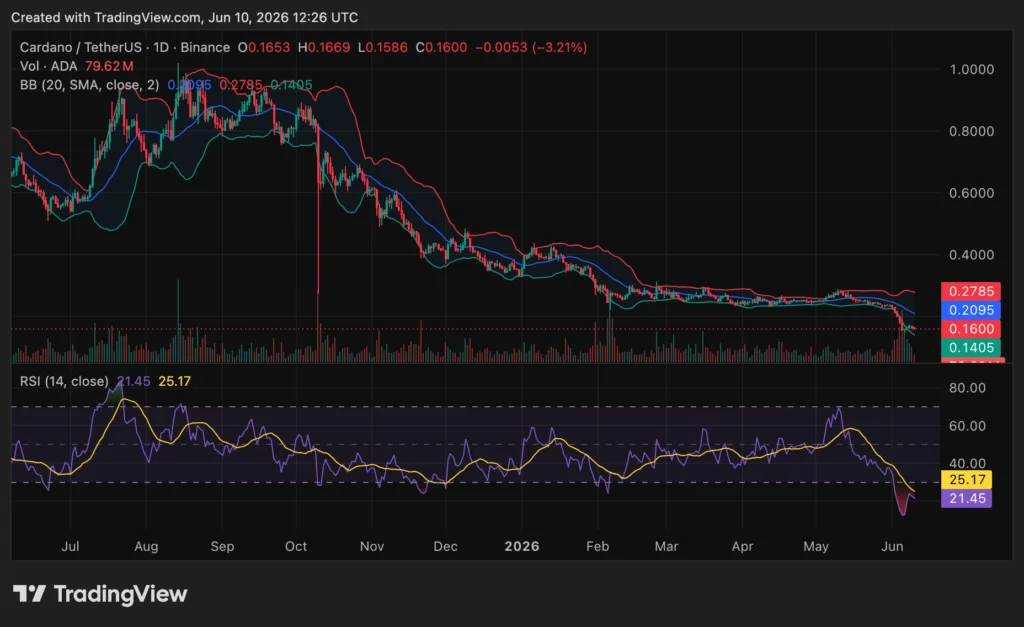
Immediate support lies near $0.1586. A daily close below that area could expose the lower Bollinger Band around $0.1405, followed by the psychological $0.12 level if broader market conditions weaken further.
On the upside, ADA must first reclaim $0.17. The next resistance zones sit near $0.18 and $0.20, while a move above the $0.2095 middle band would offer clearer evidence that the immediate bearish structure is weakening.
Derivatives data shows traders remain active
CoinGlass data showed about $715 million in futures volume and roughly $348 million in open interest. Volume increased while open interest changed only slightly, suggesting active short-term trading without a large rise in outstanding leveraged positions.
Options activity remained limited. Options volume fell more than 92% to about $6,590, while options open interest stood near $375,000. The small size means futures markets continue to provide a clearer view of leveraged ADA positioning.
ADA recorded a minor spot net outflow of about $14,150 on June 10. That movement was close to neutral when compared with earlier withdrawals of between $20 million and $40 million and inflow spikes reaching roughly $8 million to $11 million.
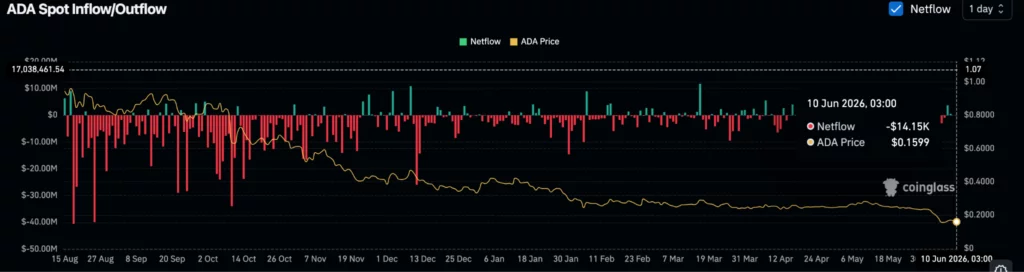
Repeated exchange outflows have not reversed the wider decline. ADA fell from near $1 in August to around $0.16, showing that lower exchange balances alone have not created enough buying demand to change the trend.
On-chain signals need price confirmation
As previously reported by crypto.news, Cardano’s social activity surged as ADA crashed, with active addresses reaching a four-month high during the selloff. Rising activity can reflect bargain buying, but it can also come from panic selling and wallet transfers.
Earlier reporting also showed that Cardano fell below $0.20 to a multi-year low after losing key support. The decline came as TapTools announced its shutdown and Charles Hoskinson warned that more Cardano projects could fail under weak market and funding conditions.
Those events may have added to market caution, but the latest age metrics show that long-term holders are no longer uniformly inactive. The change matters because dormant supply movement often increases near periods of stress or reassessment.
A short-term rebound becomes more likely if ADA holds $0.1586, recovers above $0.17 and pushes the RSI back above 30. Stronger confirmation would require a break above $0.20 and the Bollinger midpoint near $0.2095.
Failure to defend $0.1586 would keep $0.1405 in focus. Cardano’s dormant-wallet activity creates a possible turning-point signal, but price, volume and network demand must improve before the broader downtrend can be considered broken. For now, traders still face a market shaped by broad risk reduction.
Disclosure: This article does not represent investment advice. The content and materials featured on this page are for educational purposes only.