


XRP has slid to around $1, down from its $3.66 high last year, with retail in fear even as whale wallets hit record highs. Where could it finish 2026? Credible forecasts run from below $1 to $8, and the gap comes down to one question. Here is what would push XRP to each level, and which path looks most defensible.
Summary
- XRP trades near $1.04 as of late June 2026, down from a July 2025 cycle high near $3.66, with relative strength near oversold and moving averages around $1.13 to $1.14 sitting overhead as resistance.
- The forecast range for year-end 2026 is unusually wide: bearish models point below $1, conservative models to roughly $1.40 to $1.80, Standard Chartered to $2.80, and bullish publishers toward $4.36 to $8.
- Standard Chartered’s Geoffrey Kendrick cut his year-end target from $8 to $2.80 while keeping a $28 call for 2030, capturing the split between near-term caution and long-term conviction.
- The entire range turns on one question: whether the XRP token itself, not just Ripple’s network, captures the cross-border payment and settlement volume flowing through it.
- A move to $2 or $3 needs stabilization, ETF support, and better sentiment, while $5 or higher needs a genuine shift in market structure and proven token utility.
XRP (XRP) is trading near $1.04 as of late June 2026, and for holders it has been a deeply frustrating year: the token has cleared nearly every obstacle its community spent years waiting for, yet the price has done close to nothing but fall. XRP is down from a cycle high near $3.66 reached in July 2025, having declined through the back half of last year and the first half of this one, and it now sits roughly a third below where it began 2026.
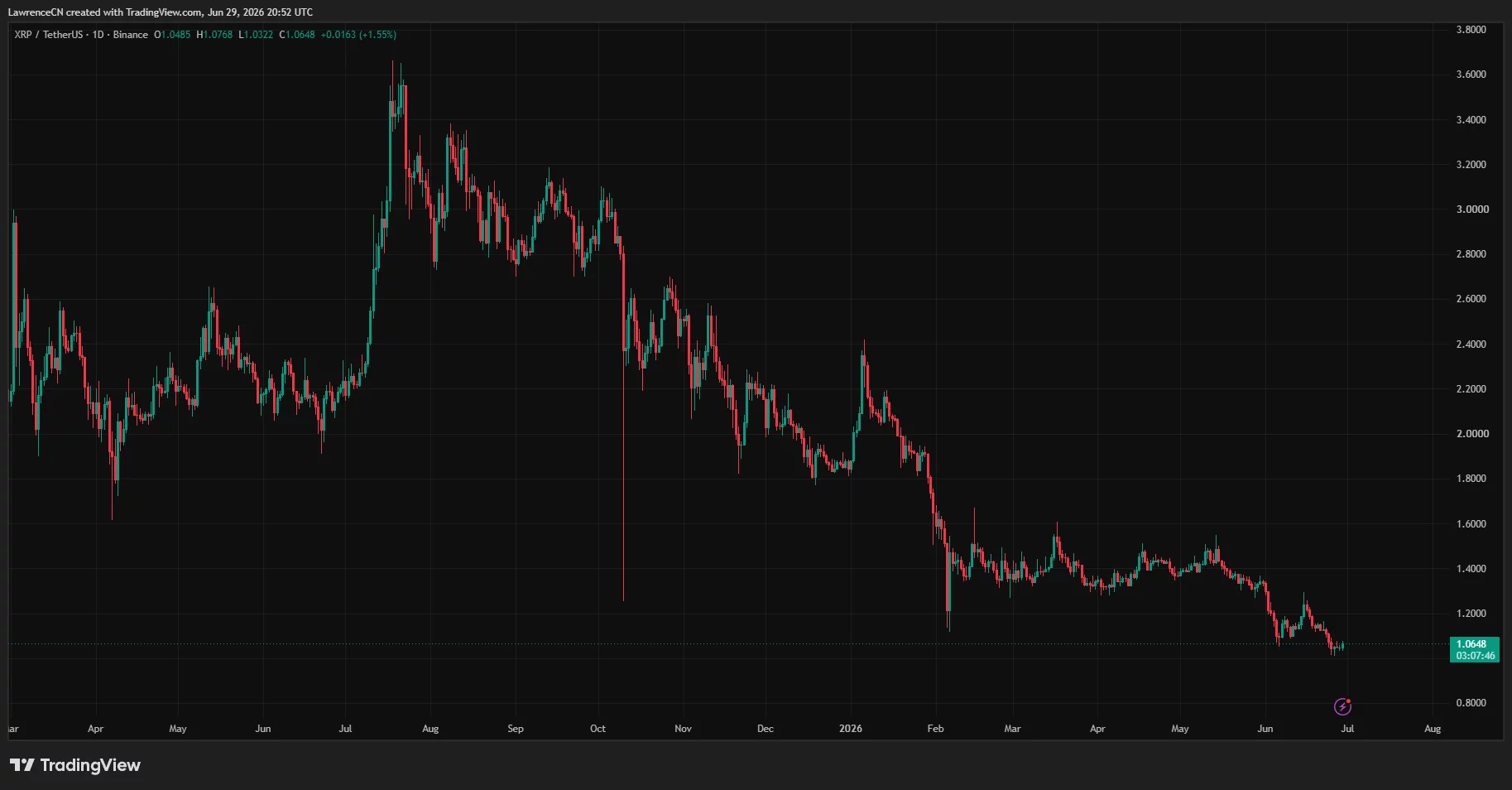
The technical picture is heavy. The relative strength index hovers near 30, at the lower boundary where downtrends sometimes exhaust themselves, and the 50-day and 200-day moving averages cluster overhead around $1.13 to $1.14, acting as the resistance XRP must reclaim to change its trend. Sentiment is weak, with retail traders fearful, even as on-chain data shows whale wallet counts at record highs, a contrarian split in which large holders appear to be accumulating while smaller holders capitulate. The question this article addresses is where that leaves XRP at the end of 2026, and the honest answer is that the credible range is enormous.
That range, from below $1 to $8, is not a sign of lazy forecasting; it reflects a real and unresolved disagreement about what XRP fundamentally is and whether its token captures value. This article works through the question methodically: where XRP stands and how it got here, the bearish case for a finish below $1, the base case in the $1.40 to $2.80 zone, the bullish case for $4 to $8, the meaning of Standard Chartered’s high-profile cut from $8 to $2.80, the enormous valuation gap that Bitwise’s own model reveals, the catalysts that could actually move the price, and three concrete scenarios for year-end.
Throughout, the goal is to show what each outcome requires rather than to pick a number, because XRP’s path depends on variables that genuinely could resolve in very different directions. The forecasts here are information, not advice, and the single most useful thing to carry through the piece is the question underneath every target: does XRP the token capture the volume that Ripple the company is winning, or does the value accrue elsewhere? Almost everything about the price follows from the answer.
Where XRP stands and how it got here
To judge where XRP might end 2026, you need the recent history, because XRP’s price has been driven as much by legal and structural events as by market cycles. The token spent years under the shadow of the United States Securities and Exchange Commission lawsuit against Ripple, and that case formally concluded in 2025, establishing that XRP is not a security when sold on exchanges and removing the single largest overhang on the token.
On the back of the resolution and a friendlier regulatory climate, XRP surged to a cycle high near $3.66 in July 2025, approaching the kind of levels its long-suffering community had anticipated for years. Spot XRP exchange-traded funds launched in November 2025 and drew over $1 billion in net inflows, another long-awaited milestone. By the standards of what the community had been waiting for, 2025 delivered nearly the full checklist.
And yet the price has fallen steadily since. From the July 2025 high near $3.66, XRP declined through the rest of the year and into 2026, sliding to around $1.04 by late June against a backdrop of broad crypto weakness. The frustration in the XRP community is precisely that the token cleared every hurdle and still dropped, which has fueled a debate about whether the good news was already priced in, whether broader market conditions simply overwhelmed XRP’s catalysts, or whether something more structural is limiting how much value flows to the token.
The current setup reflects that tension: XRP is liquid and actively traded, whale wallets are accumulating at record levels in what looks like strategic positioning, but retail sentiment is fearful, and the chart is below its key moving averages. The token sits at a level that is either a coiled accumulation base before the next move higher or a waypoint in a continued decline, and which one it is depends on the catalysts and the value-accrual question explored below. The history matters because it shows XRP has already spent its biggest bullish catalysts, the legal resolution and the ETF launch, which raises the bar for what it takes to push the price meaningfully higher from here.
The bearish case: a finish below $1
The case for XRP ending 2026 below $1 is grounded in both technicals and a structural skepticism that deserves to be taken seriously. Technically, XRP trades below its key moving averages near $1.13 to $1.14, and a market that cannot reclaim those levels is, by definition, still in a downtrend. Several model-based and technical forecasting systems remain bearish on XRP, with some, such as Gov Capital and WalletInvestor, projecting outright losses over a 1-year horizon, treating recent weakness as part of a broader risk pattern rather than a dip to be bought. If macro conditions deteriorate, whether through a broad crypto downturn, a risk-off shift in markets, or disappointing follow-through on ETF flows, XRP could test and break its current support, with technical analyses pointing to downside levels in the low-$1 range and below if the bearish trend persists.
The deeper bearish argument is structural and connects to the value-accrual question at the heart of this piece. Skeptics contend that Ripple’s commercial success, its growing roster of financial-institution partnerships and its cross-border payments business, does not necessarily translate into demand for the XRP token, because much of Ripple’s settlement activity can be conducted without participants holding XRP for any meaningful duration, and because Ripple’s own dollar stablecoin offers an alternative settlement instrument that does not require the token at all. In this reading, XRP could remain a liquid, speculative asset whose price is driven by sentiment and trading rather than by genuine, sustained utility demand, and absent a clear mechanism forcing value into the token, it could drift lower or stagnate even as Ripple thrives as a company.
The bearish case, then, is not merely a chart pattern; it is a thesis that XRP the token may be structurally disconnected from the network’s success, and that a finish below $1 is what happens if the market comes to share that view while macro conditions stay unsupportive.
The base case: $1.40 to $2.80
The base case, where a plurality of serious forecasts cluster, sees XRP recovering modestly to somewhere between roughly $1.40 and $2.80 by year-end, and it rests on a more balanced set of assumptions. Conservative, model-driven forecasters such as CoinCodex and Changelly project XRP in the $1.40 to $1.80 area, with Changelly specifically modeling a December range around $1.29 to $1.55 and an average near $1.42.
These forecasts assume XRP stabilizes, reclaims some lost ground as the broader market steadies, and benefits from continued but not explosive ETF interest, without breaking decisively above its major resistance levels. This is essentially a recovery-without-breakout scenario: XRP stops falling, grinds back toward and through its moving averages, but does not enter a new bull phase.
The upper end of the base case is anchored by the most-watched institutional forecast on XRP. Geoffrey Kendrick at Standard Chartered, after cutting his target, places XRP’s year-end 2026 level at $2.80, a number that sits deliberately between the cautious algorithmic models and the more bullish crypto-publisher calls. That $2.80 figure has become a useful benchmark precisely because it comes from a major bank instead of from automated technical models or retail-facing commentary, and it implies meaningful recovery from current levels without requiring a structural transformation in how XRP captures value.
The base case overall assumes that XRP’s concluded legal status, its live ETFs, and its institutional relationships provide enough of a foundation for a recovery toward the $1.40 to $2.80 band, supported by moderate ETF inflows and a stable-to-improving macro environment, but that the bigger moves toward $5 and beyond require catalysts that are not yet in evidence. For a token that has spent its largest bullish events already, a base-case recovery into the low-single-digits is a reasonable central expectation, and it is where the weight of credible forecasting sits.
The bullish case: $4 to $8
The bullish case for XRP reaching $4 to $8 by year-end is not fringe; it has institutional roots, but it requires conditions that go well beyond a general crypto rebound. The bullish group of forecasts starts near $4.36 and extends above $6, drawing on sources including PricePrediction.net, Telegaon, and commentary such as Dominic Basulto at The Motley Fool, who has floated $5 for XRP in 2026 with asset tokenization as a potential catalyst.
At the top of the credible bull range sits Standard Chartered’s original $8 target for 2026, which Kendrick held before cutting it and which was predicated on sustained ETF inflows and the regulatory clarity following the SEC settlement. The common thread is that these higher targets all assume XRP converts its structural advantages, concluded legal status, live ETFs, and Ripple’s institutional footprint, into real, sustained demand for the token.
What would it actually take to get there? The bullish case requires several things to align: ETF inflows would need to accelerate substantially, with some bullish models assuming flows climbing toward the multibillion-dollar range that Standard Chartered modeled as the trigger for its higher targets; the CLARITY Act or similar legislation would need to pass and codify XRP’s commodity status, unlocking institutional capital that has stayed on the sidelines; Ripple’s expanding use of XRP in cross-border settlement and its banking ambitions would need to translate into demonstrable token demand; and the broader market would likely need an altcoin-favorable phase instead of the current Bitcoin-dominated, risk-off mood.
The cleanest way to summarize it, echoing the analysts who have studied the range, is that a move toward $2 to $3 requires stabilization, ETF support, and better sentiment, while a move toward $5 or higher requires a stronger shift in market structure, institutional demand, and proven token utility. The bull case is achievable, but it is conditional on XRP answering the value-accrual question in the affirmative, which is exactly what remains unproven.
Why Standard Chartered cut from $8 to $2.80
The most instructive single event in XRP’s forecast landscape this year is Standard Chartered’s revision, because it crystallizes the shift from hope to realism. Geoffrey Kendrick, the bank’s digital-assets research lead, had previously set an $8 year-end 2026 target for XRP, a number that implied a large rally and was anchored in expectations of sustained ETF inflows and the post-settlement regulatory clarity.
As the year progressed and XRP failed to sustain the more aggressive assumptions priced into that forecast, Kendrick cut the year-end target to $2.80. The revision fit the broader weakness seen across crypto in 2026 and reflected that the catalysts, while real, were not translating into price at the pace the original target assumed. The cut matters because it came from a credible institutional source recalibrating to reality instead of from a perma-bear or a hype account, which makes the new $2.80 figure a more grounded benchmark than the targets above it.
Crucially, Kendrick left his longer-term call untouched: he kept a $28 target for XRP by 2030 even as he slashed the near-term number. That juxtaposition, $2.80 by year-end but $28 by 2030, captures the defining feature of serious XRP analysis, which is a split between near-term caution and long-term conviction. The long-term bull case rests on XRP becoming a major institutional settlement asset as Ripple’s banking and cross-border infrastructure matures, a process measured in years instead of months.
The near-term caution reflects that, right now, those flows have not materialized at the scale needed to drive the price, and the token remains hostage to sentiment and macro conditions. For anyone trying to forecast year-end 2026 specifically, the lesson of the Standard Chartered cut is sobering: even a committed long-term bull at a major bank concluded that the near-term path was far more modest than the $8 he once projected, and $2.80 now functions as the credible ceiling of the base case instead of the floor of the bull case.
The valuation gap that defines XRP
If one piece of analysis captures why XRP forecasts diverge so violently, it is the valuation work from the asset manager Bitwise, which ran XRP through a formal model and produced 2030 outcomes ranging from roughly $0.13 at the bottom to above $29 at the top. That is more than a 200-fold gap between the same firm’s bearish and bullish cases for the same token, and it sounds absurd until you see what drives it. The entire spread rests on a single assumption: whether XRP the token captures a meaningful chunk of the cross-border payment and settlement volume that Ripple is winning. Bitwise’s high case assumes it does, with XRP becoming the bridge asset that institutional value routes through; its low case assumes it does not, with banks sticking to existing systems and dollar stablecoins, including Ripple’s own, moving the money instead while XRP is bypassed.
This is the question underneath every XRP price target, and it is why the same catalysts can be read as wildly bullish or quietly bearish. Standard Chartered’s $28 by 2030 and the high single-digit-to-low-teens targets from other analysts all quietly lean on the assumption that the token captures the volume; the bearish models assume it does not.
The reason the question is so hard to settle is that Ripple can and does conduct much settlement activity without participants holding XRP for long, and its dollar stablecoin offers a token-free alternative, so the mechanism by which network success forces sustained demand into XRP is contested instead of obvious. For year-end 2026, the practical implication is that XRP’s price will be driven less by any single catalyst than by how the market’s collective answer to this question evolves. If confidence grows that the token captures the volume, the higher targets come into reach; if doubt deepens, the lower ones do. Everything else- the ETF flows, the legislation, the partnerships- ultimately feeds into that one judgment, which is why the credible forecast range is a chasm instead of a band.
The catalysts that could move XRP
Several concrete catalysts could push XRP toward one end of the range or the other before year-end, and watching them is more useful than fixating on a target. The 1st is the CLARITY Act and the broader regulatory picture. Passage of legislation codifying XRP’s commodity status into law, instead of leaving it resting on the concluded lawsuit, could unlock institutional capital that has stayed cautious, and XRP is widely seen as a beneficiary alongside other payment-focused tokens.
The 2nd is ETF flows. The spot XRP ETFs that launched in late 2025 are central to any serious forecast, because they remove supply from exchanges as providers accumulate, and the trajectory of their inflows, whether they reaccelerate toward the multibillion-dollar levels bulls assume or stagnate, will heavily influence the price. The 3rd is Ripple’s own business: its expanding use of XRP in cross-border corridors, its banking and custody ambitions, and the growth of its dollar stablecoin, which cuts both ways by validating Ripple while offering a token-free settlement path.
The 4th set of catalysts is macro and market structure: the Federal Reserve’s policy path, broad crypto liquidity, Bitcoin’s behavior, and whether the market rotates into altcoins or stays concentrated in Bitcoin. XRP, like most altcoins, tends to need a risk-on, altcoin-favorable environment to sustain large moves, and the current Bitcoin-dominated, fearful market has been a headwind.
The contrarian signal worth watching is the divergence between record whale accumulation and fearful retail sentiment, which historically can precede a reversal if the large holders prove right, though it can also simply reflect long-term holders averaging into a continued decline.
The honest framing is that these catalysts are real, but their effects are conditional, and none of them individually guarantees a direction; collectively, they will determine whether XRP’s year-end print lands in the bearish, base, or bullish zone. For a token that has already spent its biggest catalysts, the marginal mover from here is most likely the combination of ETF-flow momentum and the market’s evolving answer to the value-accrual question.
Three scenarios for XRP at year-end 2026
Drawing the analysis into scenarios clarifies the range. In the bull scenario, XRP finishes 2026 somewhere between $4 and as high as $8. This requires ETF inflows to accelerate meaningfully, the CLARITY Act or similar to pass and unlock institutional capital, an altcoin-favorable market phase to arrive, and growing confidence that XRP the token genuinely captures Ripple’s settlement volume. It is the path the most bullish credible forecasts describe, and it depends on the value-accrual question resolving in XRP’s favor while macro conditions turn supportive. It is achievable but conditional, and the bar is high given that XRP has already spent its legal and ETF-launch catalysts.
In the base scenario, the most heavily populated by serious forecasts, XRP recovers modestly to roughly $1.40 to $2.80. Support holds, the broader market steadies, ETF interest continues at a moderate pace, and XRP grinds back toward and possibly through its key moving averages without entering a new bull phase, with Standard Chartered’s $2.80 marking the credible upper edge. This recovery-without-breakout outcome fits the weight of model-based and institutional forecasting and is arguably the most likely central case. In the bear scenario, XRP finishes below $1. Macro conditions deteriorate, or ETF flows disappoint; the market comes to doubt that the token captures the network’s volume, support breaks, and XRP drifts lower as the structural skeptics’ thesis gains traction, validating the bearish models that project outright losses.
Which scenario unfolds depends primarily on ETF-flow momentum, regulatory progress, the macro backdrop, and above all the market’s evolving judgment on whether XRP the token captures the volume Ripple is winning. All 3 are live, and the wide gap between them is the most honest description of where XRP stands.
Frequently Asked Questions
Where could XRP end 2026?
The credible range is unusually wide, from below $1 to $8. Bearish models and some technical systems point below $1 if support breaks and the market doubts the token captures value. The base case, where most serious forecasts cluster, sees a modest recovery to roughly $1.40 to $2.80, with Standard Chartered’s $2.80 as the credible upper edge. The bullish case of $4 to $8 requires accelerating ETF inflows, regulatory progress, an altcoin-favorable market, and growing confidence that XRP captures Ripple’s settlement volume. The outcome depends on those catalysts and, above all, on the market’s evolving answer to whether the token, not just the network, captures value.
Why has XRP fallen to $1?
XRP is down from a July 2025 cycle high near $3.66, sliding through the back half of last year and the first half of 2026 amid broad crypto weakness. Part of the frustration is that XRP cleared its biggest catalysts: the SEC lawsuit concluded in 2025, and spot ETFs launched that November, yet the price still fell, which suggests the good news may have been priced in or overwhelmed by market conditions. The deeper question is structural: skeptics argue Ripple’s commercial success does not necessarily force sustained demand into the XRP token, especially with Ripple’s own dollar stablecoin offering a token-free settlement path. That value-accrual doubt, plus a Bitcoin-dominated risk-off market, has weighed on the price.
Why did Standard Chartered cut its XRP target?
Geoffrey Kendrick, Standard Chartered’s digital-assets research lead, had set an $8 year-end 2026 target for XRP based on expectations of sustained ETF inflows and post-settlement regulatory clarity. As 2026 progressed and XRP failed to sustain the aggressive assumptions behind that number, he cut the year-end target to $2.80, fitting the broader crypto weakness this year. Notably, he kept his $28 target for 2030 unchanged, which captures the split in serious XRP analysis between near-term caution and long-term conviction. The cut matters because it came from a credible institutional bull recalibrating to reality, which makes $2.80 a grounded benchmark and the effective ceiling of the base case instead of the floor of the bull case.
Can XRP reach $5 or more in 2026?
It is possible but conditional on several things aligning. The bullish forecasts of $4.36 to $8 assume ETF inflows accelerate substantially, the CLARITY Act or similar passes and unlocks institutional capital, the market rotates into an altcoin-favorable phase, and XRP demonstrably converts Ripple’s settlement footprint into sustained token demand. As analysts who have studied the range put it, a move to $2 to $3 needs stabilization, ETF support, and better sentiment, while $5 or higher needs a stronger shift in market structure, institutional demand, and proven token utility. The bar is high because XRP has already spent its biggest catalysts, so reaching the bull range requires new, larger drivers instead of a simple market rebound.
What is the value-accrual question for XRP?
It is the single question underneath every XRP price target: whether the XRP token itself, not just Ripple’s network, captures the cross-border payment and settlement volume flowing through it. Bitwise’s formal model shows why it matters so much, producing 2030 outcomes from about $0.13 to above $29, a more than 200-fold gap driven entirely by this assumption. The high case assumes XRP becomes the bridge asset institutional value routes through; the low case assumes banks and dollar stablecoins, including Ripple’s own, move the money while XRP is bypassed. Because Ripple can conduct much settlement without participants holding XRP for long, the mechanism forcing demand into the token is contested, which is why forecasts diverge so violently.
Are whales accumulating XRP?
On-chain data shows XRP whale wallet counts at record highs even as retail sentiment sits in fear, a contrarian divergence in which large holders appear to be accumulating while smaller holders capitulate. Bulls read this as strategic positioning ahead of a potential reversal, on the logic that large, informed holders are buying weakness. The cautionary reading is that record whale accumulation can also reflect long-term holders averaging into a continued decline that does not reverse on schedule, so it is a supportive signal instead of a guarantee. It is one of the more constructive data points in XRP’s current setup, but like every catalyst here, its payoff depends on the broader market and the value-accrual question resolving
This article is information, not financial or investment advice. XRP price levels, indicator readings, and analyst forecasts reflect data available as of June 28, 2026, are point-in-time, and can change rapidly. Cryptocurrency is highly volatile, and you can lose money. Price predictions are inherently uncertain, and the scenarios described are not guarantees. Do your own research and consult a qualified financial professional before making any investment decision.